HAK-PAR Party Assembly: THE KURDISH QUESTION MUST BE SOLVED ON THE BASIS OF THE EQUALITY OF TWO PEOPLES
This text was translated automatically from the original (Turkish). Read the original
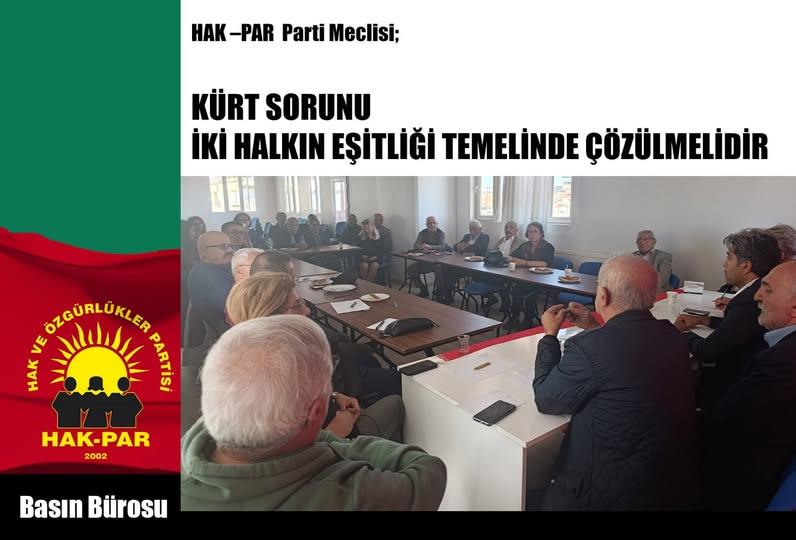
HAK-PAR Party Assembly;
THE KURDISH QUESTION MUST BE SOLVED ON THE BASIS OF THE EQUALITY OF TWO PEOPLES
At the Party Assembly meeting held in Diyarbakır on October 18, 2025, recent political developments in Turkey and the region, as well as the situation of the Kurdish patriotic movement, were evaluated.
It was decided to share the following concluding declaration with the public.
To the Press and the Public
The war that began two years ago with Hamas's attack on Israel was not limited to Gaza. Israel razed Gaza to the ground. It killed nearly 70,000 Palestinians, including Hamas's leadership cadres. It spread the war to a broad geography encompassing Syria, Jordan, Lebanon, South Yemen, and even Iran.
The war changed many balances in the region. The BAAS regime collapsed in Syria, creating destructive effects for Iran and the Iran-leaning radical Islamist rulers and organizations that terrorized the entire region.
The war's shaking of the anti-Kurdish order established in the region has also produced positive results in terms of the liquidation or neutralization of colonialist regimes—which are also hostile to Kurds, usurp our people's most fundamental legitimate rights, and try to destroy them through genocides—and proxy structures fostered through them.
Although a ceasefire agreement between Hamas and the State of Israel was recently announced, jointly signed by the US, Egypt, Qatar, and Turkey under US President Donald Trump's plan, it is obvious that this situation is very fragile.
The calming of the Middle East and the establishment of a new order will take a considerable amount of time.
In this process where major changes will take place, Kurds, instead of being supporters of anti-Kurds as they were in the early 1900s, must stand in a position that observes their national interests.
After the BAAS regime collapsed in Syria, the jihadist HTS leader Colani, brought to power with the support of Turkey, the US, and Western countries, has not been able to ensure stability.
Turkey is the main actor motivating and directing Colani's rule, which chooses to suppress the objections of Alawite Arabs on the Mediterranean coast, Druze in the south, and Kurds in the east with violence and threats.
Turkey opposes an administrative structure suited to Syria's multinational, multicultural structure out of concern that Kurds might also benefit, and imposes the unitary state model on Syria as well.
The SDF—built in eastern Syria together with Arab tribes and with US financing/support—has long seemed to have forgotten the 'Rojava revolution' and claimed it wants to integrate into the Syrian Arab state ruled by HTS. Although the SDF occasionally demands an autonomous structure in Kurdish cities and a 'decentralized democratic Syria' where the legitimate rights of Kurds are guaranteed, how they will proceed remains uncertain due to the pressures exerted by the Turkish state, which also utilizes Öcalan.
Used as a local force for operations in line with the interests of the US and coalition forces in the anti-ISIS struggle in Syria, the SDF enjoys serious international sympathy due to its tradition of struggle, which cost the lives of thousands of Kurdish young men and women, and its secular structure.
The SDF, whose core is formed by the PYD, abandoning its past hostile attitude toward other Kurdish organizations, convening a national conference encompassing all Kurds with the support of Masoud Barzani, and adopting a constructive stance in this conference based on decentralization, highlighting national demands, and ensuring all Kurdish organizations jointly interlocute with Damascus had enabled the SDF to receive sympathy and support from Kurds in all parts.
However, one should not expect a rational, stable policy from the SDF, which has failed to rescue itself from the PKK/PYD line.
Expecting an outcome that will bring a smile to the faces of Kurds in Western Kurdistan (Rojava) without taking a stance against the collaborationist policies of the PKK and Öcalan—which are against Kurds and in favor of colonialists, particularly in Northern Kurdistan—is a futile effort.
Already, Mazloum Abdi's statements regarding joining the Syrian army show that steps will be taken along the line of Öcalan, who went into action at the signal of MHP leader Devlet Bahçelí.
On the other hand; in Turkey, where broad social segments are crushed under heavy economic burdens, impoverishment is increasing, income inequality and lawlessness have reached their peak, social unrest is suppressed and pushed to the background through masterfully stoked anti-Kurdish, Islamist, and militarist rhetoric and policies.
It would not be wrong to say that the AKP=MHP government has been quite successful in distracting society's attention from core issues through anti-Kurdish politics, which are camouflaged by anti-Israelism and the fight against the PKK that they have managed to turn into domestic politics material.
AKP seems to have achieved the desired result from the suffocating atmosphere it created for a long time through operations launched against the legal extensions of the PKK, by imprisoning parliamentarians and appointing trustees to municipalities.
It has now concentrated the same operations on the Main Opposition Party, the CHP.
Many mayors, notably the presidential candidate and Istanbul Metropolitan Municipality Mayor, have been dismissed from office and arrested on corruption charges. All corruption files that had been ignored until now have been brought to the fore, and the CHP has been kept busy with its own internal problems.
In the CHP winning many mayoralties in the recent elections and becoming the first party, the government's economic policies that drove the public to despair, as well as secret alliances made with the DEM and the redirection of Kurdish votes to the CHP, were decisive.
The AKP=MHP government, with the 'Terror-Free Turkey' project it recently developed, now seems to have succeeded in detaching the DEM from the CHP and drawing it to its side by also utilizing Öcalan.
This situation will cause serious new developments in both Turkish politics and Kurdish politics, and the political scene will be reshaped.
If successful, the new position that the DEM will take in the AKP=MHP-Öcalan line following the liquidation of the PKK will also cause serious developments in Kurdish politics.
The 'state' project called the 'Terror-Free Turkey project', which started with the call of MHP leader Bahçelí and Öcalan and aims at the laying down of arms and liquidation of the PKK, continues.
We know that the underlying development leading to this is the reshaping of the region that started and rapidly developed in the Middle East.
The aim is both to strengthen internal unity in Turkey by integrating Kurds into the Turkish sovereignty system without relaxing the policy of refusing Kurds their collective rights, and to prevent any potential Kurdish gain in Rojava (Western Kurdistan).
For this purpose, this is why Öcalan and the DEM were called to duty as a state project.
Öcalan, knowing no bounds in serving the state, has called on Kurds and the PKK to integrate with the Turkish state without putting forward any demands.
DEM cadres, shuttling between Imralí and Parliament, have packaged Öcalan's call for Kurds to abandon their collective rights and integrate with the state as 'a major development for the solution' and are trying to prepare Kurdish society to comply with this official state policy.
Following the PKK convening its congress to take a decision of dissolution, and a group of guerrillas symbolically burning their weapons, work is also underway in Western Kurdistan for the integration of the SDF by accepting statelessness with the Syrian state.
While the 'Terror-Free Turkey project', consisting of 51 people from different parties in Parliament and renamed 'national solidarity, brotherhood, and democracy commission', continues, the state has not taken any steps; it has contented itself with an activity of merely listening to the summoned individuals and institutional representatives to date.
We support the liquidation of the PKK, which they themselves established and brought as a plague upon the Kurds; however, we reject the policy of 'gifting Kurds to the Turkish entity' by forgoing their legitimate rights through Öcalan and the PKK.
The Kurdish question is Turkey's most fundamental problem and must be solved on the basis of the equality of two peoples.
Turkey must be restructured in a federal manner.
Kurdish identity must be granted constitutional guarantees, the Kurdish language should be an official language alongside Turkish, and it must be used freely at all stages of education,
On the other hand;
The PKK's hegemony over Kurdish politics is gradually weakening.
The 40-year sham fight maintained with heavy costs without any results, and the PKK's carrying of the war to the cities by digging trenches and barricades in 2015/16, are causing Kurds to seriously question the PKK.
The weakening of the PKK's military presence and the policies pursued jointly by Öcalan and the AKP=MHP government aimed at the liquidation of the PKK with complete and absolute surrender, without putting forward any reasonable demands, and the integration of the SDF in Rojava have caused, and continue to cause, serious discussions among Kurds and even within the DEM itself.
Under these conditions, although scattered patriotic parties and cadres, notably HAK-PAR, object to the ominous policies developed by Öcalan and the PKK in cooperation with the state, they remain very inadequate against the large mechanism formed by the PKK=DEM and the state.
Unfortunately, the patriotic movement is scattered and ineffective.
We believe that in the face of the heavy degeneration infused into Kurdish politics by the joint efforts of the state and the PKK, the patriotic cadres organizing as soon as possible, the unity of Kurdish patriotic cadres, and the formation of an effective force is an unpostponable duty.
HAK-PAR will do its utmost to rally the patriotic movement and build a strong alternative.
Rights and Freedoms Party
HAK-PAR Party Assembly
More Statements
StatementTurkish
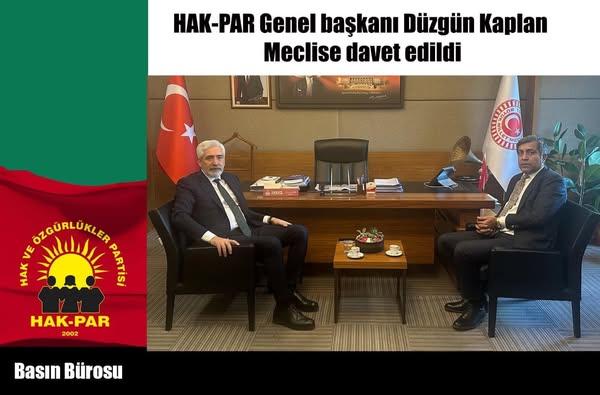
HAK-PAR Genel başkanı Meclise davet edildi.
StatementTurkish
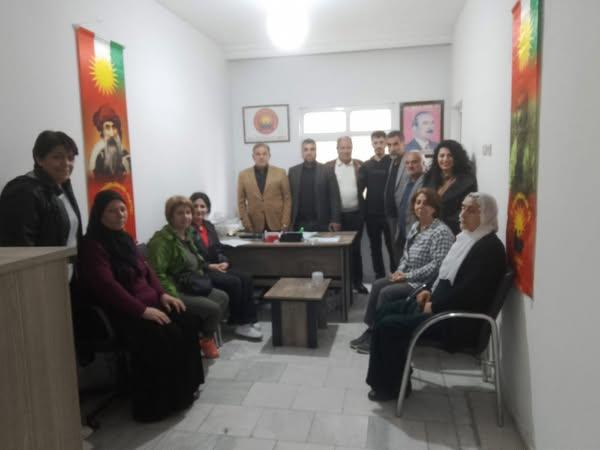
HAK-PAR Mardin ili Kızıltepe ilçe kongresi yapıldı.